
Posts · Industrial / export-facing buyers
Short-circuit withstand capability: what transformer buyers should ask
A transformer may see only a handful of serious through-faults in its life, but each one subjects the windings to enormous mechanical forces. Its ability to survive them is designed in, not added later.
Posted on
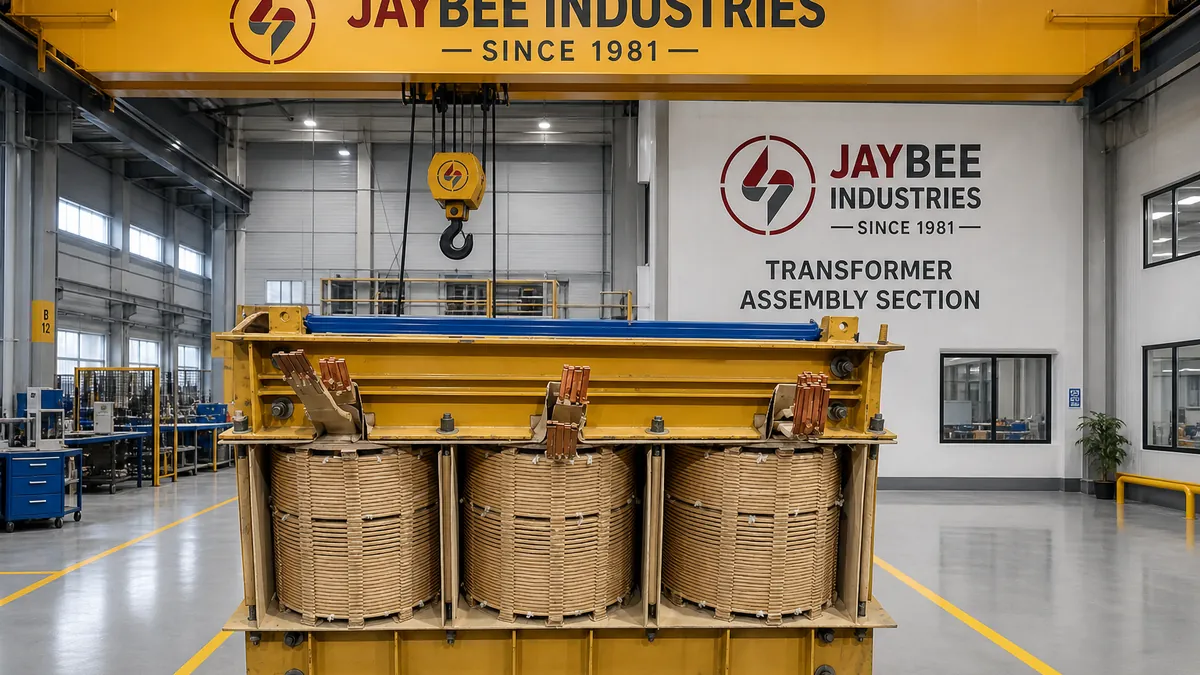
When a fault occurs on the cables, busbars or equipment downstream of a transformer, a current many times the rated current flows through its windings until the protection clears it. This current produces strong electromagnetic forces between and within the windings, along with rapid heating. A transformer that is not designed and built to withstand these forces can suffer winding displacement, which may not cause immediate failure but weakens the insulation and leads to a breakdown later.
What determines the fault current
The fault current through the transformer depends mainly on its own impedance and on the strength of the supply network behind it. A lower-impedance transformer on a strong network sees a higher fault current. For this reason the buyer should tell the manufacturer the system fault level at the HV terminals, or at least the supply voltage and the utility’s stated fault level.
How the design handles it
Withstand capability depends on the winding geometry, conductor sizes, insulation and the clamping structure that holds the windings and core together. Designers calculate the forces for the specified fault conditions and make sure the windings, spacers, clamps and leads can carry them. Manufacturing quality matters as much: correct winding tension, drying, pressing and clamping keep the winding tight over the years. Relevant Indian and international standards set out the requirements for thermal and dynamic ability to withstand short circuits.
How it is demonstrated
Withstand can be demonstrated by a short-circuit test on a representative unit at a recognised laboratory, or by calculation and comparison with a tested design, as permitted by the applicable standard and the buyer’s specification. Utilities and some large buyers require a short-circuit test report for the design. Ask what evidence the manufacturer can offer for the rating you are buying.
Questions to ask before ordering
- What system fault level has the design been checked for?
- Is there a short-circuit test report for this design or a comparable one?
- What winding and clamping arrangement is used?
- What is the guaranteed impedance and its tolerance?
- How are windings dried and pressed during manufacture?
Protecting the transformer in service
Good withstand capability is not a reason to tolerate repeated faults. Correct protection settings that clear faults quickly, coordinated upstream and downstream, reduce the stress each event causes. After a heavy through-fault, consider oil and electrical tests, such as winding resistance, ratio, and where available frequency response analysis, to check for internal movement.
Talk to us
Share the system fault level and protection details with your enquiry, and our engineers will explain how the offered design addresses short-circuit withstand. We prepare offers on request; we do not publish prices.
Send your enquiry
Call toll-free 1800 309 9948, message us on WhatsApp at +91 98162 95407, or email info@jaybeeindustries.com. Mention this article and your site location so the right team responds. We reply with technical options; we do not publish prices, and every offer is prepared for your specification.
Related pages on this site
Request a quote Call 1800 309 9948 WhatsApp +91 98162 95407 info@jaybeeindustries.com